
Many wildfire losses begin at small, easily overlooked ignition points — a drifting ember that settles in a gutter, dry debris beneath a deck, or a gap that allows heat to reach combustible materials. Wildfire protection efforts often focus on larger, visible hazards such as brush clearance, defensible space, and roof hardening. Yet in practice, these smaller ignition points are frequently responsible for how and where damage begins.
This post is designed to be a quick, practical overview of common ignition points around homes, and simple ways to reduce risk. The goal is to share useful information that can be applied by homeowners, property managers, and wildfire safety professionals alike.
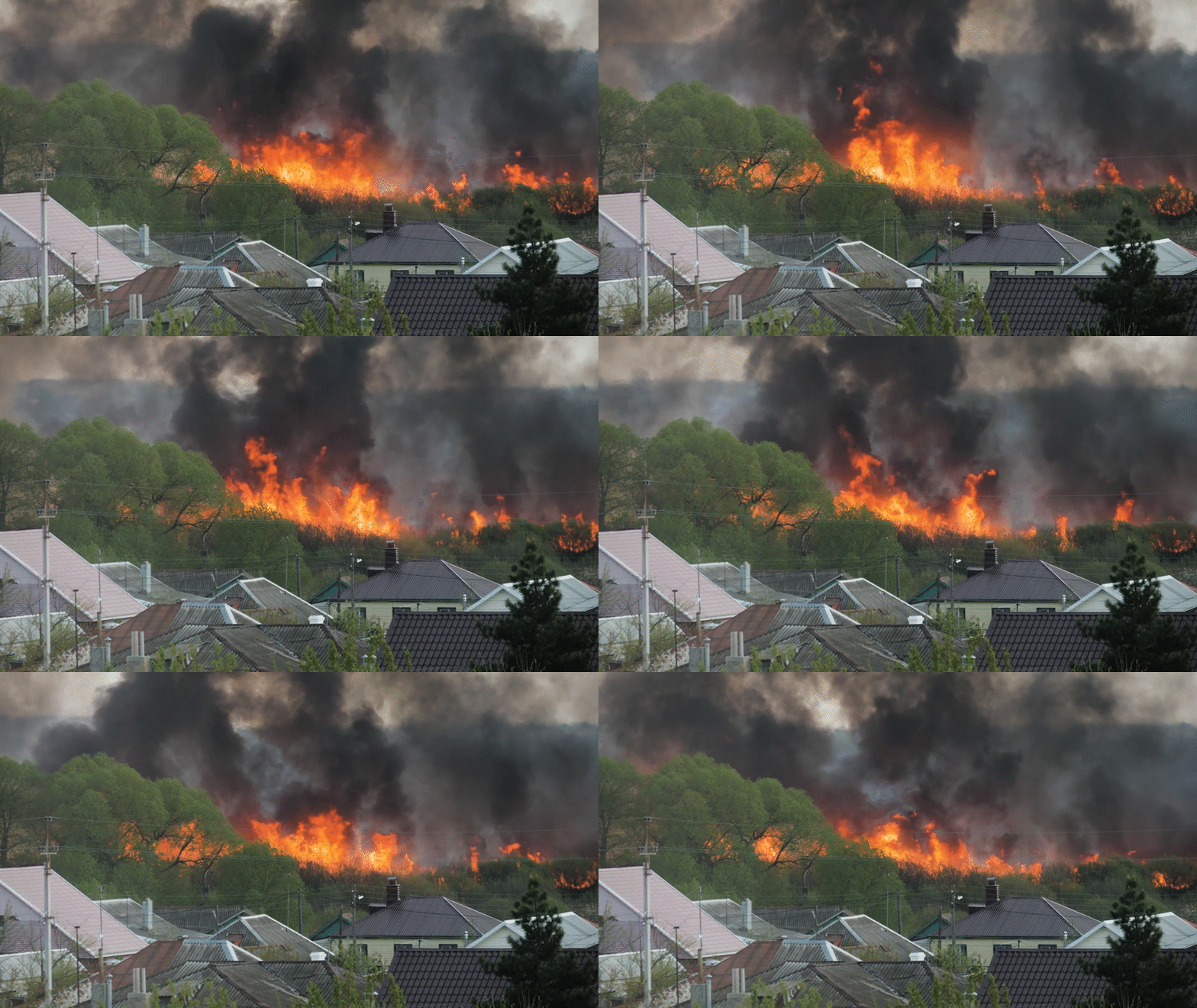
Homes located where developed areas meet wildland vegetation — known as the wildland-urban interface — can be exposed to embers and radiant heat even when flames are not directly visible.
What We are Seeing This Season
In recent wildfire seasons, the patterns of home ignition have become clearer. Even when a home is not directly in the fireline, embers and radiant heat often create the most common ignition pathways.
A few key trends observed across many wildfire-prone areas:
- Ember intrusion remains the most common ignition source for homes during wildfire events
- Roof edges, vents, and gutters continue to be high-risk areas
- Combustible landscaping and storage near the structure often create a rapid ignition path
This is why the “last 30 feet” around the home remains the most critical area for mitigation.
Common Ignition Points
These are the most common vulnerabilities contractors identify during inspections and mitigation work:
1. Roof Edges, Gutters, and Valleys
Embers collect in gutters and roof valleys, where debris can ignite and spread quickly.
Why it matters: once the roof ignites, the home’s exposure increases dramatically.
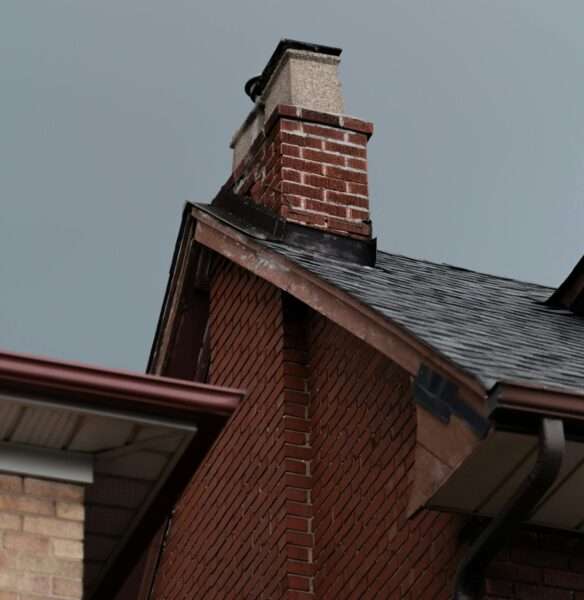
Roof edges and gutters are common locations where embers can accumulate and ignite nearby combustible materials.
2. Unprotected Vents and Soffits
Vents and soffits can allow embers and hot gases into the attic or wall cavity.
Why it matters: attic ignitions often start small and spread fast.
3. Decks, Under-Deck Storage, and Exterior Wood Features
Decks and under-deck storage are common ignition sources because they often accumulate debris and are exposed to embers.
Why it matters: once a deck ignites, it can act as a bridge to the home.
4. Combustible Landscaping Near the Home
Plants, mulch, and shrubs placed close to walls or windows can ignite from embers or radiant heat.
Why it matters: this creates a direct pathway from vegetation to structure.
5. Stored Materials and Outdoor Items Near Structures
Common items that increase risk include:
- Firewood stacked against walls
- Outdoor furniture cushions
- Cardboard, paper, or plastic bins
- Potted plants and dry garden debris
Why it matters: these items can ignite quickly and spread flames to nearby siding or windows.
Practical Mitigation Principles
These are simple, client-facing mitigation strategies that are commonly recommended and work best when applied in layers.
Reduce Ignition Sources
- Keep roofs and gutters clear of debris
- Remove combustible materials from near the home
- Clear leaves and pine needles from around vents and openings
Increase Fire Resistance
- Use ember-resistant vent covers or screening
- Protect vulnerable exterior surfaces where possible
- Consider fire-resistant landscaping materials near the structure
Temporary Exterior Protection (Ahead of Wildfires)
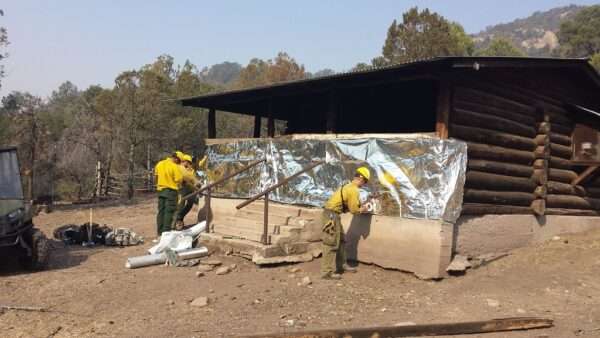
Fire crews wrap a cabin in aluminized structure wrap to help protect it from radiant heat and embers during wildfire exposure. (Photo: U.S. Department of Agriculture (USDA), via Flickr (CC BY 2.0).
In some situations, temporary protective measures can be used to add an extra layer of defense when wildfire risk is elevated. One example is Aluminized Structure Wrap (ASW), which is designed to reflect radiant heat and provide short-term exterior protection during wildfire exposure.
Best practices for use include:
- Purchasing and staging materials well ahead of wildfire season
- Storing materials in a dry, accessible location
- Installing only when conditions and evacuation timelines allow
- Using temporary wraps as a supplement, not a replacement, for defensible space and structural hardening
Safe Storage and Maintenance
- Store firewood and combustible items away from the home
- Keep decks and surrounding areas free of debris
- Use enclosed storage for flammable items when possible
Layered Protection (Simple Zones)
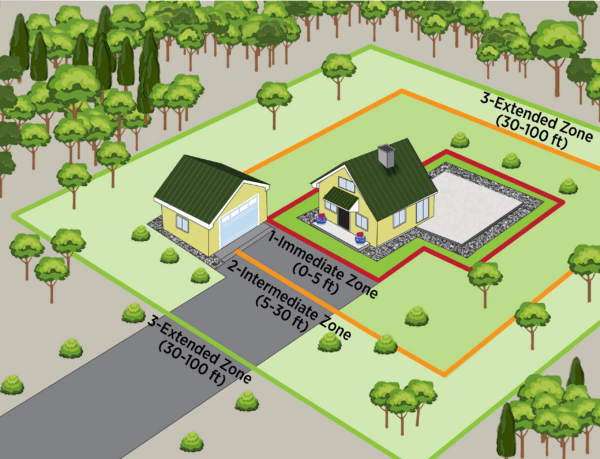
- Zone 1 (0–5 ft): clear debris and avoid combustible materials, install noncombustible ground cover, use fire-resistant or noncombustible materials for decks, porches, railings, or fences that attach to the home.
- Zone 2 (5–30 ft): keep low-fuel landscaping and maintain spacing, plant trees no closer than 30ft to the home, trim branches up to 6ft to 10ft from ground and at least 10ft from structures.
- Zone 3 (30–100 ft+): reduce fuel continuity and manage vegetation, remove vegetation next to outbuildings, for trees 30 to 60ft from the home, space mature canopies at least 12 ft apart, for 60 to 100 ft from the home, space canopies at least 6 ft apart.
Sources
- National Fire Protection Association (NFPA) – Wildfire Preparedness
- CAL FIRE – Ready, Set, Go Program
- Firewise USA – Home Ignition Zone Research
Subscription
This post was designed to be a quick, practical update that’s easy to share with others and use in conversations about wildfire safety. If you’d like to receive future updates, mitigation insights, and useful resources, subscribe below.
Join Our Mailing List
Smart wildfire protection starts here.
Thank you for subscribing!
You’re now on the list.